


 (Photo source: Pexels)
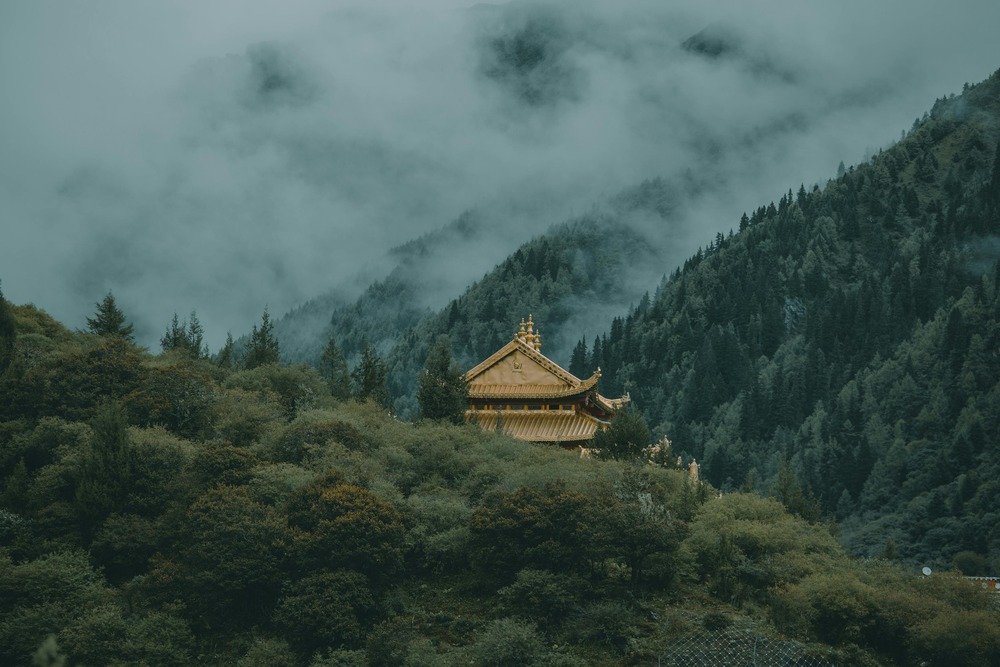
During the time of Shakyamuni Buddha, four great Bodhisattvas - Avalokiteshvara of Great Compassion, Manjushri of Great Wisdom, Ksitigarbha of Great Vows, and Samantabhadra of Great Conduct manifested into the human realms to guide and liberate sentient beings. China’s Four Sacred Buddhist Mountains—Mount Wutai, Mount Emei, Mount Putuo, and Mount Jiuhua are each regarded as the spiritual cultivation site of one of the Four Great Bodhisattvas. Among them, Mount Jiuhua is the sacred site where Kṣitigarbha Bodhisattva manifested his presence.
Kṣitigarbha Bodhisattva manifested at Mount Jiuhua approximately 1,500 years after Shakyamuni Buddha’s passing. During that time, a young man named Kim Gyo-gak, a royal of the Kingdom of Silla (present-day South Korea), renounced worldly life to become a monk out of his passion for studying Buddhism. After his ordination, he journeyed to Anhui Province in China with his white dog, Shan Ting, in search of Buddhist Dharma. Kim Gyo-gak’s boat was driven ashore after a fierce storm at sea. He abandoned it and walked toward the mountain.
He ended up living in a cave under severe hardship, surviving on wild grasses and mountain fruits, and even consuming “Guanyin soil” (earth) to stay alive. With no water nearby, he endured the exhausting daily climb of 500 metres to fetch water from the cliff below.
One morning, while meditating, he was suddenly bitten by an insect. When he opened his eyes in shock, a woman in black veil appeared before him, kneeling in repentance and said that her son had offended his holy practice. To make amends, she magically manifested a clear spring next to the rocky edge for his use. After speaking, she vanished. Soon after, a fresh spring of water emerged near the cave, flowing continuously regardless of the weather.
After many years of cultivating at Mount Jiuhua, Kim Gyo-gak, who was meditating in the cave, was once accidentally discovered by a group of poets who were on an outing in nature. Everyone waited quietly for him at the entrance of the cave until he finally emerged at noon. He did not look like a Chinese person. According to legend, the appearance of Kṣitigarbha Bodhisattva was quite distinctive; he was said to be about seven feet tall, with a very high and broad forehead. The poets asked him where he had come from, and the monk introduced himself, saying that he came from the Kingdom of Silla.
The poets were deeply ashamed to learn that a practitioner had long been living in hardship on the mountain, unnoticed. These poets then became his Dharma guardians and quickly reported it to the mountain owner, a wealthy landowner, Elder Min, who was a devout Buddhist. Touched by Kim Gyo-gak’s austere cave practice, Elder Min visited him and, together with the poets, built a simple abode for him.
Once he was settled, Bhikkhu Kim Gyo-gak devoted himself wholeheartedly to spiritual practice and the study of the Dharma, while his Dharma guardians often came seeking his guidance. Elder Min, a devotee of the Triple Gem, offered alms to 100 monks each day but always found only 99, until Bhikkhu Kim Gyo-gak was invited, completing the number of 100. Deeply moved by his austere practice, Elder Min later even allowed his own son to follow Kim Gyo-gak into monastic life.
One day, Elder Min said to Bhikkhu Kim Gyo-gak, “As you can see, more and more devotees are coming here to seek the Dharma. In the future, people will also come to settle and practice here. Shouldn’t you expand the monastery grounds? The entire Mount Jiuzi (Mount Jiuhua’s former name) belongs to me, no matter how much land you need, you may have it.”
In response, Ksitigarbha Bodhisattva, manifesting as the Bhikkhu Kim Gyo-gak, replied that he required only as much space as the shadow of his robe would cover. Elder Min was doubtful and asked whether he was certain, yet Bhikkhu Kim insisted. He then cast his robe into the air, and it miraculously spread across the entire mountain. Astonished by this marvel, Elder Min joyfully dedicated the whole mountain to him.
In response, Kṣitigarbha Bodhisattva, manifesting as Bhikshu Kim Gyo-gak, said that he required only as much space as the shadow of his robe would cover. He then cast his robe into the air, and it miraculously spread across the entire mountain. Astonished by this marvel, Elder Min dedicated the whole mountain to him.
As poets debated what to name the mountain, its nine lotus-shaped peaks inspired the name Mount Jiuhua. From that time on, the Dharma flourished there, attracting many followers, and the monastery was successfully expanded. Bhikkhu Kim Gyo-gak guided and liberated countless people, and many practitioners from Korea journeyed there to follow him and enter monastic life under his guidance. As the monastic community continued to grow, resources gradually became scarce, giving rise to the saying, “too many monks, too little porridge.” Bhikkhu Kim Gyo-gak considered sending some of the monastics elsewhere, but everyone was deeply devoted to the Buddhadharma. Despite the difficult living conditions, many chose to remain, and these devoted practitioners became known as “emaciated beings.”
Over time, Kim Gyo-gak came to be revered as an incarnation of Kṣitigarbha Bodhisattva. By day, he expounded the Dharma and meditated by dusk. At night, the sounds of instruments of punishment from the hell realms were often said to echo around Mount Jiuhua. According to folklore, Kim Gyo-gak would descend into the underworld at night to save suffering beings, earning him titles such as the “Kṣitigarbha Bodhisattva Who Manifested Deeds of Compassionate Transformation” and the “Golden Kṣitigarbha.”
Kim Gyo-gak ascended Mount Jiuhua at the age of 24 and attained parinirvana at 99 on 30th day of the seventh lunar month, having spent 75 years in devoted practice on the sacred mountain. His long presence there came to be remembered as a profound bond between Ksitigarbha Bodhisattva and the sentient beings of China.
Translated by Michelle Lee
Share 


